You’re spending money on a biodegradable straw because you want to offer your customers a better alternative. But how do you know you’re actually getting what you paid for? If you’re telling your customers it’s biodegradable or compostable, you need to be confident that claim is true. Here’s what to look for.
As more South African restaurants, cafés, hotels and food businesses look for alternatives to conventional plastic, words like plant-based, biodegradable and compostable are appearing everywhere.
But a green label doesn’t necessarily make a product green.
The CSIR has specifically warned South African consumers and businesses to be cautious about products such as straws, cups and takeaway packaging that make compostability claims without clear evidence to support them. Misleading claims aren’t always deliberate, but confusion around what materials are made from, how they break down and what different certifications actually mean is still widespread.
For a business buying thousands of straws at a time, knowing what to look for matters.
But first, what is PLA?
PLA, or polylactic acid, is a bioplastic that can be made using renewable plant-derived feedstocks rather than conventional fossil-based plastic feedstocks.
But “plant-based” and “compostable” are not interchangeable claims. A product’s compostability needs to be demonstrated against recognised standards under specified composting conditions.
This distinction is particularly important in South Africa. SANS 1728 requires products making compostable or biodegradable claims to be appropriately identified and for those claims to be supported by relevant standards and evidence. South Africa also has SANS 17088, which covers the identification and labelling of plastics suitable for recovery through aerobic composting.
The simple hot-water check
There is a quick demonstration that can help you spot an obvious difference between some PLA straws and conventional plastic straws.
Place the straw in very hot water. A standard PLA straw with relatively low heat resistance will begin to soften and lose its rigidity as it heats up. A conventional plastic straw designed for hot conditions may remain rigid.
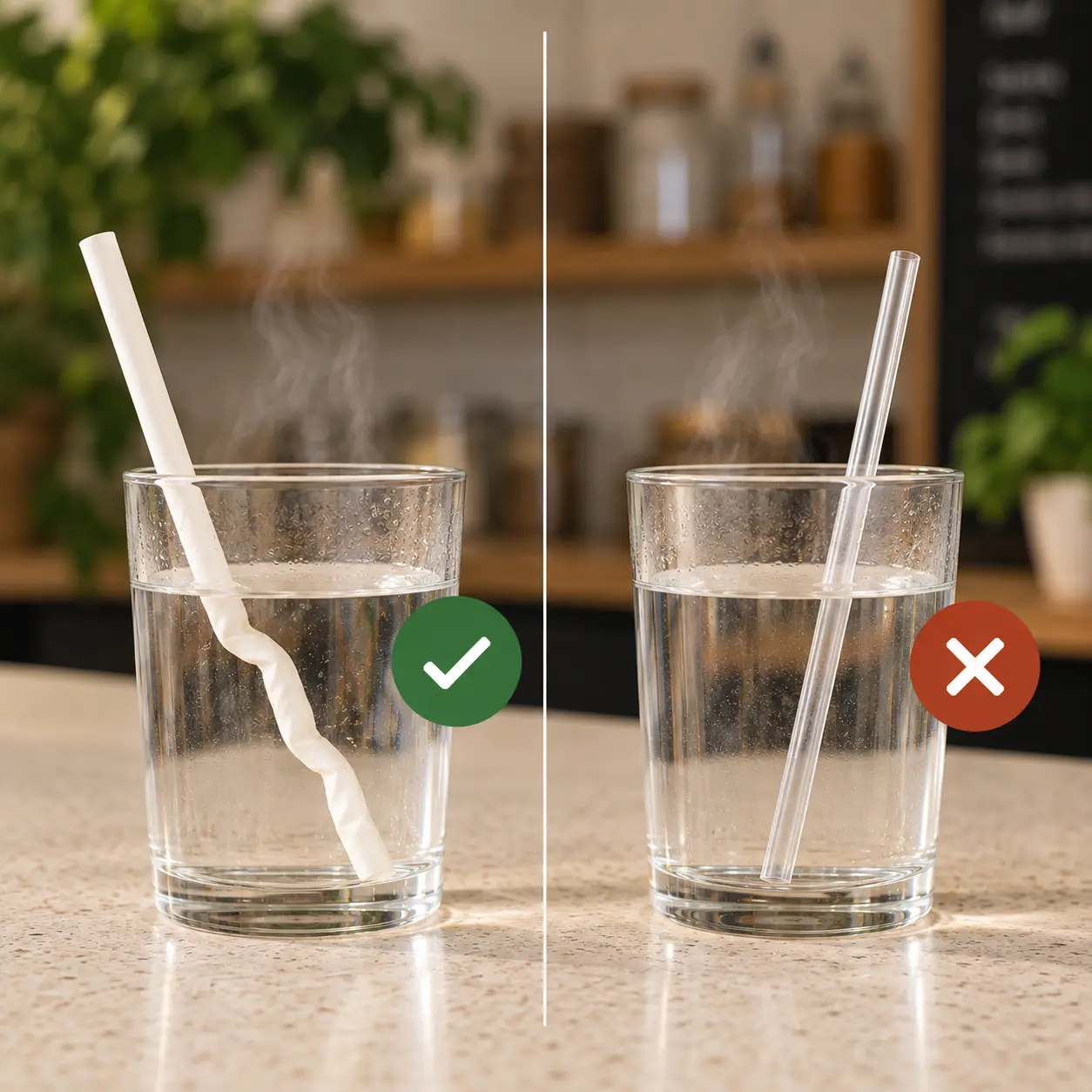
That makes the demonstration useful for showing customers and staff that two products which may look similar can behave very differently.
Remember, it is a clue, not a certification test. Different formulations and heat-resistant bioplastics exist, so whether a straw bends in hot water cannot, by itself, prove its chemical composition or compostability. That proof should come from testing and certification.
Look beyond the word “biodegradable”
“Biodegradable” sounds reassuring, but on its own it tells you very little about where, how or how quickly something will break down.
So when a supplier describes a straw as biodegradable or compostable, ask a few more questions:
- What material is it made from?
Look for a specific material identification rather than a vague environmental description. - Is the finished product certified?
Ask for the relevant certificate and check which product it actually covers.
- Which standard does it meet?
Recognised industrial-compostability standards include EN 13432 and ISO 17088. South African guidance recognises international standards including EN 13432, ISO 17088 and ASTM D6400 for compostability claims.
- Is it home or industrially compostable?
These are not the same thing. Industrial composting relies on controlled conditions including temperature and moisture; a product certified for industrial composting should not automatically be described as suitable for a garden compost heap.
- Can the certification be verified?
Independent certification bodies such as DIN CERTCO maintain certification systems for compostable products, providing something more substantial than a claim printed on a box.
Why this matters for your business
For a customer, a straw might seem like one very small part of an order. For a food business, it can be thousands of purchasing decisions repeated throughout the year.
If you’re telling customers that you’ve moved away from conventional plastic, you need to be confident that the product behind that claim stands up to scrutiny. That protects your sustainability commitments, your reputation and ultimately the trust of the people buying from you.
It also helps customers make better decisions at the bin. A product being compostable does not mean it will simply disappear wherever it is thrown away. Industrially compostable products are designed to break down under particular composting conditions, and appropriate collection and composting infrastructure still matter.
Don’t buy the colour. Check the credentials.
A straw can be clear, white, green or printed with leaves. None of those things tells you whether it is compostable, but the packaging, supporting documentation and certification should.
With our BioAfrica range, our approach is simple: environmental claims should be backed by evidence. When you’re choosing alternatives to conventional plastic for your business, look beyond what the product looks like and ask what it is made from, what standards it meets and whether those claims can be independently verified.
Because if you’re making a better choice for your business and your customers, you should be able to know exactly what you’re buying.